
The Hermit Tarot Card Meaning: Upright, Reversed, Love & Yes or No
"I thought truth would feel like certainty / But it feels more like a question."
On February 21, 2024, I pulled The Hermit, and before I'd even looked at the art properly, the read landed in my body: stay home and rest. You're not well. I wrote it down exactly like that. The deck I was using showed an elf collecting fireflies for his lantern, and the guidebook's phrase was "inner restoration." I didn't need the guidebook. I needed permission, and the card gave it.
That's the thing most Hermit write-ups miss. They hand you a list (solitude, introspection, wisdom) and stop. But The Hermit isn't a vocabulary word. It's an instruction, and the instruction changes depending on where you're standing when it shows up.
The Hermit at a Glance
| Number | IX (9), Major Arcana |
| Upright keywords | Solitude, introspection, inner guidance, soul-searching, wisdom, retreat, mentorship |
| Reversed keywords | Isolation, loneliness, withdrawal that's gone stale, perfectionism, refusing guidance, rejoining the world |
| Astrology | Virgo (ruled by Mercury) |
| Element | Earth |
| Hebrew letter | Yod (the hand; the seed point) |
| Yes or no | Not yet. Wait and look inward first. |
What The Hermit Looks Like (and Why It Matters)
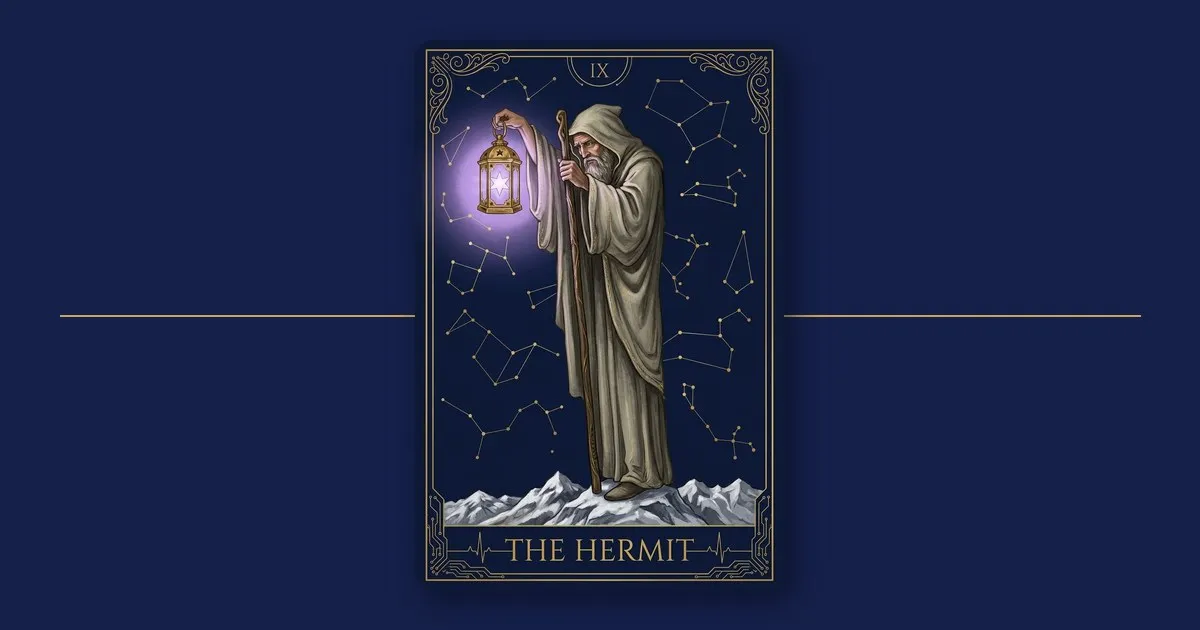
In the Rider-Waite-Smith deck, an old man in a grey cloak stands alone on a snowy peak. He holds a staff in his left hand and a lantern in his right, and inside the lantern is a six-pointed star. He isn't looking at you. He's looking down, at the path.
Three details carry most of the meaning:
- The lantern only lights a few feet ahead. The Hermit doesn't get a floodlight on the whole mountain. He gets enough light for the next step. That's the deal this card offers: not the full map, just enough clarity to keep moving.
- The star inside the lantern. The light he's carrying isn't the sun, borrowed from outside. It's a star, his own fixed point. The Hermit's whole job is to remember that light and protect it.
- He's standing on a summit. He already climbed. The Hermit isn't a beginner wandering off; he's someone who did the work, got high enough to see, and is now holding the light for whoever's coming up behind him.
One of my favorite readings of this image comes from Meditations on the Tarot, the anonymous Christian Hermeticist classic: the Hermit isn't sitting in meditation, and he isn't working. He's walking. He's in a third state between contemplation and action, holding the lantern at heart height. I come back to that constantly. The Hermit isn't stillness. It's slow, deliberate movement led by something internal.
The Hermit Upright Meaning
Upright, The Hermit says: step back from the noise and consult your own light.
The first seven or eight cards of the Major Arcana are largely about learning to function in the world: getting educated, getting socialized, building an ego that can drive the Chariot. The Hermit is where that outward momentum stops on purpose. You've proven enough. Now the question is what's actually true for you, separate from what everyone else is doing.
In practice, that can look like:
- Pulling back from social obligations to think something through properly
- A season of study, therapy, journaling, or spiritual practice
- Choosing your own counsel over the group chat's
- Seeking out a mentor, or realizing you've become one
- Rest. Sometimes just rest.
Important: The Hermit is a metaphorical state, not a literal one. You don't have to move to a cabin. I've pulled this card on a packed meeting day, and the read that dropped in was: when you feel the meh setting in, channel the Hermit. Listen. Learn. Empathize. Lead. Shine your light. The Hermit can show up in a conference room. It's about where your attention is anchored, not where your body is.
The Hermit Reversed Meaning
Reversed, The Hermit usually points to one of two failure modes, and they're opposites.
1. You won't go in. You need the solitude and you're avoiding it, filling every quiet moment with input so you never have to hear yourself. The reversed Hermit here is a nudge to finally take the retreat you keep postponing.
2. You won't come out. This is the more common one, and the sneakier one. The cave got comfortable. Solitude turned into isolation. Reflection turned into rumination, or into a quiet superiority: I've figured something out that nobody else gets. The lantern was supposed to light a path back down the mountain, and instead you've set up camp at the summit.
When I pulled The Hermit reversed on June 21, 2025, the words that came were loneliness, perfectionism, seclusion. It was paired with Strength, and the message was clear: have some compassion for yourself for trying to get it perfect alone. The reversed Hermit often means it's time to rejoin the world, ask for help, and let the work be seen before it's "done."
The Hermit in Love and Relationships
If you're single: The Hermit usually isn't a "someone's coming" card. It suggests a period of being genuinely, intentionally on your own: getting clear on who you are and what you want before you go looking for it in someone else. That's not a consolation prize. People who've done Hermit work choose much better partners.
If you're in a relationship: One or both of you may need more space than usual. That isn't automatically a red flag. Healthy relationships can hold a partner's inward season. The question The Hermit raises is whether the withdrawal is restorative (they'll come back fuller) or avoidant (they're using solitude to dodge a conversation).
Reversed in love: Loneliness inside a relationship, emotional walls, or someone who's retreated so far they've stopped reaching back. Or, on the hopeful side, the end of a solitary season and a readiness to let someone in.
The Hermit in Career and Money
At work, The Hermit favors depth over visibility. It's a card for research, strategy, deep focus, independent work, and mastering a craft rather than marketing it. If you've been chasing the next promotion, The Hermit may ask whether that ladder leads anywhere you actually want to go.
It's also the mentor card. You might be about to meet someone whose experience saves you years, or you might be the person others are quietly coming to for guidance. Notice which.
With money, The Hermit counsels a quiet, considered approach: review, simplify, don't make big moves on hype. One of my own pulls paired The Hermit with the Six of Pentacles, and the read was that the hidden spiritual work I was doing would eventually let me be generous with material resources. The Hermit's money advice is rarely "go get it." It's "get clear first, and the right moves get obvious."
The Hermit for Health and Wellbeing
The Hermit often says rest. That means real rest, not productive rest or rest you have to earn. My February 2024 pull said it bluntly: you're not well, stay home. Pay attention to your body's request for quiet, sleep, and fewer inputs. (As always, tarot is a reflective tool, not medical advice. If something's wrong, see a professional.)
If The Hermit keeps showing up alongside rest cards like the Four of Swords, your deck is not being subtle.
The Hermit as Feelings
As feelings, The Hermit describes someone who's inward, reflective, and private about you or the situation. They may care deeply but need time alone to understand what they feel before they can say it. Don't mistake their quiet for indifference. And don't expect a fast answer.
The Hermit as a Person
As a person, The Hermit is often an older or wiser figure: a teacher, therapist, spiritual director, or mentor. It can also be an introvert who keeps a small circle and thinks before speaking. Sometimes it's you, and the card is pointing at your own inner wisdom as the advisor you've been ignoring.
The Hermit as Advice
Turn down the volume. Take the question you've been polling everyone about and sit with it alone. Ask: what do I actually know here, underneath what I've been told? Then take one small step by the light you have. You don't need the whole path lit.
The Hermit: Yes or No?
The Hermit is generally read as "not yet" or "look inward before you decide." It's not a hard no. It's a signal that the answer isn't ready because you aren't done thinking. Ask again after you've had real time alone with the question.
The Hermit, Astrology, and Numerology
Virgo. In the Golden Dawn system most modern decks inherit, The Hermit belongs to Virgo, the earthy, discerning, Mercury-ruled sign of analysis, refinement, and service. That connection is more useful than it first looks. Virgo is the sign that sorts: what to keep, what to let go of, what's actually worth your attention. The Hermit's retreat isn't vague navel-gazing. It's a Virgoan process of review and integration. You withdraw so you can digest what's happened and decide what to harvest.
Number 9. Nine is the last single digit, the number of completion and wisdom gathered before a new cycle starts. The Hermit (IX) sits just before the Wheel of Fortune (X), and that sequence matters: you gather your inner wisdom so you can meet the next turn of fate from a grounded place. In numerology, a 9 personal year has the same flavor: endings, review, and clearing space.
Yod. The Hebrew letter attributed to The Hermit is Yod, the smallest letter, from which all the others are said to be formed. Small, concentrated, seed-like. A single point of light in the dark.
Going Deeper: The Hermit and the Wise Old Man
Carl Jung called this figure the Wise Old Man, one of the archetypes of the Self. Jung met his own version in 1913, in a dream: an old man with kingfisher wings and bull's horns, carrying a set of keys across a blue sky. Jung named him Philemon and kept painting and talking with him for years. The figure became, by Jung's account, a kind of inner teacher. That's The Hermit's essential function: he isn't the light. He reminds you that you have one.
The archetypal psychologist James Hillman adds a twist I find indispensable. The Wise Old Man (the senex) has a twin, the eternal youth (the puer). The senex is structure, patience, boundaries, depth. The puer is spark, play, possibility. Cut the senex off from the puer and you get the shadow Hermit: rigid, bitter, alone on the mountain because nobody else is good enough. Keep them together and the old man's lantern holds a young fire.
I've lived this tension. When I wrote "Alone With the Flame," the Hermit track on my concept album ARCÆON, I described the card as the first moment where nothing is being forced, proven, or performed, and I noted that it's deeply uncomfortable. It is. Withdrawal sounds peaceful until you're in it and there's nothing left to distract you from yourself. On May 5, 2024, I pulled The Hermit next to an oracle card that said you are being your own worst enemy, and my entire journal note was: "WOW. FUCK. OK." That's a Hermit moment too.
What My Own Pulls Say About The Hermit
TarotPulse exists because one card is a mood but a month of cards is a message. So here's my data. Across 702 recorded readings from January 2024 to April 2026, The Hermit showed up 14 times, only once reversed. Looking back at those entries, a pattern shows up that no guidebook would have told me: my Hermit almost never meant "be alone." It showed up on meeting days, on days I needed to be present for my kids, on a day it sat right next to an oracle card called Community. ("What a juxtaposition," I wrote. "Go inward. Quiet your mind. But also lean on and into community.")
For me, The Hermit turned out to be about where I lead from, not where I hide. Your Hermit may mean something different. That's the point of tracking it.
Journal Prompts for The Hermit
- Whose voice have I been listening to more than my own lately?
- If I could only see one step ahead, what would that step be?
- Is my current solitude restoring me or hiding me?
- What do I know now that I couldn't have known a year ago? Who might need to hear it?
- Where is the young, playful spark inside my seriousness?
Frequently Asked Questions
Is The Hermit a good card?
Yes, though it's a quiet good. The Hermit brings wisdom, clarity, and self-knowledge. It can feel lonely or slow, especially if you were hoping for action, but it's rarely a warning. Its main caution is about staying withdrawn too long.
What does The Hermit mean in a love reading?
Usually a need for space, self-reflection, or time alone before (or within) a relationship. For singles, it suggests focusing on yourself before seeking a partner. For couples, it may point to one partner's inward season. Reversed, it can signal loneliness or emotional distance.
Does The Hermit mean someone is thinking about me?
Possibly, but privately. As feelings, The Hermit describes someone reflecting on you quietly and slowly. They're unlikely to say much until they've worked it out for themselves.
What zodiac sign is The Hermit?
Virgo. The Hermit is associated with Virgo in the Golden Dawn tradition, which links the card to discernment, analysis, refinement, and quiet service.
What does The Hermit reversed mean?
Either avoiding the solitude you need, or staying in solitude too long until it becomes isolation, loneliness, or perfectionism. Often it's a sign to come back out, reconnect, and share what you've learned.
Track Your Own Hermit
Meanings like these are a starting point. Your deck has its own dialect, and the only way to learn it is to keep the receipts. TarotPulse tracks your pulls over time so you can see which cards keep showing up, what they show up with, and what they actually mean in your life. Your Hermit is waiting to tell you something. Start counting.